What happened in the opening scene?
In the first few minutes of silent witness season 9 episode 2 (Choices) we see a club owner (Mr Modest) giving his girlfriend an engagement ring, and then exiting the car to enter his club, we then cut to a scene of an all black 4x4 left running around a corner from the club Mr Modest owns, "thats them over there" is heard in a carribean accent from the window of the 4x4 we then see a black males hand come out of the window of the car brandishing a Mac 10 or "bigmac" as it is so oftenly called, then a slow motion scene of the men in the car shooting uncontrollably into a crowd of partygoers, bouncers and Mr modest himself. We see Modest's fianceé fall to the ground after being shot in the head.
Who where the characters involved in the opening scene?
Ainsley Modest, the Gunmen, Terry Bannard and other bouncers and, Helen Roach
Who was the primary audience for these episodes?
due to certain aspects of this program, I feel that it is aged at the middle aged gap and more specifically the 35 to 55 age gap we can see this because of the way teenagers are portrayed, not only that but the crumminess of the slang that is used, but i do feel that this is the delivery of the scripts fault not the actual script itself. but this does lead me onto the style of elder people talking about younger people.
Sherlock
In the opening scene of Sherlock A Scandal In Belgravia, we see sherlock meeting watson and moriarty, moriarty tries to blow all three of them up, and then gets sherlock and watson almost shot aswell.
In the opening scene we see Sherlock, Watson and Moriarty.
I think that the primary audience for this show was aimed at almost all ages! from 16-60 the onlry reason i say this is because Sherlock Holmes originally written as a book could be read by anyone, and even in the actual production its not as risqé as it could have been, (even though there was some partial nudity) there was no strong drug reference even though in the original novels Sherlock was an opiates addict.
the secondary audience was literally everyone, infact, Sherlock appealed to almost everyone regaurdless of age, sex or gender.
I particually liked the text coming up on the screen from when sherlock is texting or even
trying to unlock the 'Womans' phone.
I disliked how much the story had fallen away from the original novels even though it hadnt strayed too much.
Edge Of Darkness
In the opening scene of compassionate love we see a meeting of 'eco warriors'and on the other end of the spectrum we see her father having a quiet
Thursday, 13 December 2012

Friday, 7 December 2012
understand the requirements of working to a brief
The brief we had to work toward was for our film to be 10 seconds long, include and E4 logo and then also be appropriate for the demographic group that would watch E4, this would be a teenager in a middle class family. We then double checked that we had done so by putting our videos on various social platforms such as social networking sites, viva voce’s , focus groups and written reports on the subject at hand. We used others feedback to help us reach this, for that we used questionnaires. Not just on paper but on survey monkey too!
During the planning to our film we had to think about copyrighted material, when we could use the sports hall for our original idea, when this backfired we had a lot less to worry about, we did have to make sure that we could film in the college corridors and what time they were least busiest to make our video even better (or just less disturbance) The equipment we used needed little planning or organising as we were just using handheld cameras and a tripod, but for our first production (space invaders) we had to use a jib, this was obviously going to be more difficult to get the equipment we needed to use. Other issues we encountered was not having enough talent release forms for our original production that then went wrong and we had to change the video that we were going to finish off.
We managed our time fairly well, we only had Wednesday mornings free to use the gym when doing “space invaders” this then obviously overlapped with talents lessons and other stuff involving cast and crew, so obviously a certain amount of time keeping was needed for our video to run smoothly. The work load, however was another issue, we had only got half the video done in a little under an hour, this was because of the amount of people we had to organise for our space invaders video, but on top of that we were still on top of everything that we needed to be, e.g. being allowed to use the sports hall when we did, what copyrighted material we couldn’t use and also what OFCOM and ASA would and wouldn’t allow us to do in our Esting. The space invaders unfortunately did not pull through and we had to change our idea at the last minute, that’s when we came up with the idea of “punch” this was when Alex got punched by Zac then flew back into some lockers and somehow spawned an E4 logo from no were. This was basically the same as the last video in terms of a stop motion animation, Time keeping was both less and more of an issue, on one hand we had to be careful of how long we actually had to film but at the same time it was only two people who had to be filmed so it wouldn’t be too hard to film them both in a short amount of time. The appraisement we had received off of our teacher was both about the camera movements that I had taken, this was the 180 degree spin when Alex had gotten punched by Zac this then was followed by Alex jumping in every shot this then looked like Alex was flying from being punched so hard. On the other hand we did receive feedback about the camera being a little jumpy from time to time.
The feedback we received of the public was mostly positive, mostly about the various camera angles and the different techniques we had used, even the almost none existent storyline came up once or twice. On the other hand we had received more comments about the jumpiness of the camera, not only this but another complaint about how they couldn’t understand the story line; this was somewhat annoying as we had earlier received a compliment about the story line, so now do not know what to do about our narrative. We also got some feedback saying that our video fitted the narrative well; this was obviously good to hear, as we were working toward the narrative that had stated that.
If I did go on to work in the media industry I would probably make sure that I had a good repertoire of actors I could trust before trying anything that would require more than a few actors, not only this but I would also keep an eye on the time I had to film and edit and publish certain videos.
There are different ways briefs can be shown, one is Contractual, Contractual is when the brief is outlined in an employment contract, an example of this is when a man or woman is asked to create a production for a company. Negotiated is when you need to work collaboratively with someone to make the brief and discussing and agreeing things together. Formal is when a client explains what they want and their requirements to you in a meeting where as informal would be when the client discusses these over the phone. Commission is when a work person is requested and they do a contract. Tender is when companies are sent briefs via post or email.
Monday, 22 October 2012
Final Esting Evaluation (& questionnaire)
Our idea for an ESting is a live action stop motion animation space invaders game. We would be having a wide open space such as the college gym and then having students move around up the top as the bricks for the game. We would then have a student at the bottom for the turret of the game moving and firing students at the bricks at the top. When a student has been hit we will make them disappear into a piece of clothing. Once all the students are gone the game will be completed. For this project we would need many students to participate as well as a wide open space to film in and also the camera and necessary equipment to ensure the camera is focused at a bird’s eye view on the game. We will also have the students make sounds when they are shot or just add a space invaders theme song to the video.

E4 is a British digital television channel, launched as a pay-TV companion to Channel 4 on 18 January 2001. The "E" stands for entertainment, and the channel is mainly aimed at the lucrative 15–35 age group. Programming includes U.S. imports such as The Ricky Gervais Show, The Cleveland show, The O.C., Smallville, Veronica mars, Glee, Everwood, What About Brian, Desperate Housewivs, How I Met Your Mother, 90210, One Tree Hill, Ugly Betty, Scrubs, and formerly Friends. Other programming includes British shows such as Shameless, Hollyoaks, Skins, The Inbetweeners, Misfits and Made In Chelsea. Some U.S. imports, such as Desperate Housewives and Ugly Betty are screened on E4 up to one week ahead of their Channel 4 broadcasts. Its most successful broadcast to date was on 11 October 2010 when an episode of The Inbetweeners pulled in over 3.7 million viewers Their target audience would be aimed at the elder teen generation e.g. 16-19 and possibly even early to late 20's.


In order to receive feedback, we had to send our work to others via the internet. We used various other social networking sites such as Twitter, Facebook, and Tumblr. We then used all 20 results and made a table on excel then wrote the following results up on Microsoft word;
Excellent 3
Good 5
Average 8
Bad 3
Terrible 1
Analysation
Good feedback
Good camera movement used, E.g. when Alex gets punched the camera does a 180 degree spin, this created more “tension” in the short film.
There was good “continuity” in your short. I enjoyed the small but sweet story line.
Timing seemed to be spot on I couldn’t see much wrong with the timing.
Bad feedback
The camera was too jumpy.
I couldn’t understand much because of the jumpiness of the camera.
The E4 logo could have been created better.
these results wheren't just off of the internet we also had paper questionnares these helped out immensley
in reviewing our work we could formulate an action plan and start to ammend our action plan, this could also be done with an oral presentation of our work to the public and then get results off of the general public
in reviewing our work we could formulate an action plan and start to ammend our action plan, this could also be done with an oral presentation of our work to the public and then get results off of the general public
These results helped out immensely as we could use them to better our production further.
from this we learned what people loved most, this would be the 180 degree spin that I added into the production to create more of a fight scene feel, not only this but too also add on some extra time, this is also accompanied by the "good timing" response we see that as a good thing because of the jumping Alex did, if our timing wasn't correctly done we would have Alex all over the place but because it was done perfectly it did not make much of a difference to our film, obviously with the good news, also comes bad. We find out that our camera work is a little too jumpy even after using the tripod that was given to us, but also because the E4 logo was a bit too rubbish, we had a lot of technical difficulty when trying to put the logo on the lockers, not only this but it seems a little too squared off. This seems too help us even further if we didn’t have any problems with the logo in the first place, unfortunately we did. Without feedback there would be no way to know what people liked and disliked about our production.
We had a little bit of feedback about our genre, some said that it was either “comedy” or “action” none thought any different, it was about 16 for action and 4 for comedy. This was fairly odd as I hadn’t thought about any sort of genre, we just made it in the hope that it would tick all of the boxes needed for it to be an E4 esting. Prior to making the punch video we had a separate idea, this was to make a space invader themed esting, this went wrong after half of the cast decided not to turn up, so that obviously hindered us in our efforts to make an esting.
The narrative behind our story would be the fight between our two characters; this can make people want to believe something bad has happened between the two of them. In the film itself we see the two characters (Alex and Zac) bump into each other this was the reason for the punch in our production but we do see some comments by others that say “what is the back story” and other stuff along those lines, this even then connotes that people didn’t understand the whole bumping into each other, this just shows the inaccuracy of the whole reviewing of our esting.
We chose to do a stop motion action styled production instead of a clay mation comedy that the rest of the class did. This obviously affected our style, e.g. we couldn’t do as much impossible stuff as others, such as being fired out of a cannon or have our feet detach and dance around on their own, but however we can do things like making Alex fly or even get punched!
The technical quality that we were working at could have been better to be honest, but there is only so much you can do with equipment that you are given at college, we were given a film camera to take photos with, which just goes to show how the quality could have been made greater!
The brief we had to work toward was for our film to be 10 seconds long, include and E4 logo and then also be appropriate for the demographic group that would watch E4, this would be a teenager in a middle class family. We then double checked that we had done so by putting our videos on various social platforms such as social networking sites, viva voce’s , focus groups and written reports on the subject at hand. We used others feedback to help us reach this, for that we used questionnaires. Not just on paper but on survey monkey too!
During the planning to our film we had to think about copyrighted material, when we could use the sports hall for our original idea, when this backfired we had a lot less to worry about, we did have to make sure that we could film in the college corridors and what time they were least busiest to make our video even better (or just less disturbance) The equipment we used needed little planning or organising as we were just using handheld cameras and a tripod, but for our first production (space invaders) we had to use a jib, this was obviously going to be more difficult to get the equipment we needed to use. Other issues we encountered was not having enough talent release forms for our original production that then went wrong and we had to change the video that we were going to finish off.
We managed our time fairly well, we only had Wednesday mornings free to use the gym when doing “space invaders” this then obviously overlapped with talents lessons and other stuff involving cast and crew, so obviously a certain amount of time keeping was needed for our video to run smoothly. The work load, however was another issue, we had only got half the video done in a little under an hour, this was because of the amount of people we had to organise for our space invaders video, but on top of that we were still on top of everything that we needed to be, e.g. being allowed to use the sports hall when we did, what copyrighted material we couldn’t use and also what OFCOM and ASA would and wouldn’t allow us to do in our Esting. The space invaders unfortunately did not pull through and we had to change our idea at the last minute, that’s when we came up with the idea of “punch” this was when Alex got punched by Zac then flew back into some lockers and somehow spawned an E4 logo from no were. This was basically the same as the last video in terms of a stop motion animation, Time keeping was both less and more of an issue, on one hand we had to be careful of how long we actually had to film but at the same time it was only two people who had to be filmed so it wouldn’t be too hard to film them both in a short amount of time. The appraisement we had received off of our teacher was both about the camera movements that I had taken, this was the 180 degree spin when Alex had gotten punched by Zac this then was followed by Alex jumping in every shot this then looked like Alex was flying from being punched so hard. On the other hand we did receive feedback about the camera being a little jumpy from time to time.
The feedback we received of the public was mostly positive, mostly about the various camera angles and the different techniques we had used, even the almost none existent storyline came up once or twice. On the other hand we had received more comments about the jumpiness of the camera, not only this but another complaint about how they couldn’t understand the story line; this was somewhat annoying as we had earlier received a compliment about the story line, so now do not know what to do about our story line.
If I did go on to work in the media industry I would probably make sure that I had a good repertoire of actors I could trust before trying anything that would require more than a few actors, not only this but I would also keep an eye on the time I had to film and edit and publish certain videos.
Monday, 15 October 2012
planning an Esting

Real Name: Wee Baby Sam
Alias: Wee Baby Seamus
Age: 18
Occupation: To ride horses, drink vodka and find the cure for Diabetes (type 1)
(vodka unlocks his secret powers, such as super strength, the ability to transform into a lamp for only one hour, and the ability to smell terrorists from roughly a mile away, but no farther and no closer than one mile).
Other info: His addiction to Vodka is killing his relationship with his horse Wee Baby Ketamine.
 |
| The set where Wee Baby Seamus would be.
Our idea for an Esting is a live action stop motion animation space invaders using people. We would need a wide open space like the college sportshall and then have students position themselves around up the top as the space invaders for the game. We would then have two students at the bottom for the turret and have it firing out students at the space invaders in which will explode into a piece of clothing. Once all the students are gone the game will be completed. For this project we would need many students to participate as well as a wide open space to film in and also the camera and necessary equipment to ensure the camera is focused at the bird’s eye view of the game. We will also have the students make sounds when they are shot or just add a space invades theme song to the video.
E4 is the sister company of Channel 4 however E4 is more aimed at a larger youthful target audience. Many of the shows which feature on E4 are mainly US imports which consist of big shows featured in America. For example "Scrubs" and "The Cleveland Show". Although having a young audience it still manages to attract an older audience however with such shows as "Desperate Housewives". However the main audience consists mainly of teenagers from around 15 -19. I had based this on the shows which E4 provides which are mainly teen dramas like "Hollyoaks" However its main home-grown teen dramas are that of "Skins", "Inbetweeners" and "Misfits". These shows have been the most popular among teens since E4 had started cranking out such teen dramas. As shown by the ratings these shows although are not brought out very often get the highest ratings of any of their other shows. This occurred mainly in which the ratings showed at least 3.7million tuning in to an episode of inbetweeners. Although these shows are based at a much younger audience I believe that due to the other shows which are some more adult dramas I believe that the target audience is around 15-25. However in terms of gender I believe that E4 targets both genders with their comedy as it appeals both to male and female however some do target them both individually. For example “Glee” attracts mainly more female viewers when “Misfits” would attract more of a male audience. I think our idea is suitable as it seems that all though E4 cranks out new innovative shows, it has a certain amount of nostalgia about it and appreciated the stylistic appeal of nostalgia as shown by the "street fighter" type Esting. Our esting is also going to be created by college students so we are the age group and understand what the target audience want as it is nostalgic about the old space invaders games as they were part of our childhood. Not only this but the whole concept is stylistically cool and fun to do. While scouting locations for our Esting we has decided on using the college gym due to its convienience and wide open area. Because of the balcony we can get a good birds eye view and with the open area can fit a farely large amount of people. In order to get access to this location we had to get a release form and have it signed by the owner to ensure we can use it and in doing so will not damage the property. Not only this, but we had to do a risk assesment to assess our safety and well being while ensuring we cannot cause problems for ourselves or others. Not only this we must ensure that in instructing the talent, we do not put them in harms way.   In terms of the location we had to set up camera on the balcony to get a good angle on the space invaders Esting. In doing this we identified that getting a birds eye view was unrealistic as we had to get a angle which gave us more space to work in Making sure we got the angle a bit higher we used a jib to get the camera over the balcony. In doing this we can get a good angle without any obstruction. However it wasn't without its trials. In attaching the jib and tripod the tripod couldn't hold the jib as it tilted sideways. As shown in the picture to the left. However in supporting the tripod we were able to get a beter result. as seen here we managed to keep the image straight while also getting the best angle on the sports hall with the maximum space. Not only this but we managed to get a central look at the hall. In terms of the location we had to set up camera on the balcony to get a good angle on the space invaders Esting. In doing this we identified that getting a birds eye view was unrealistic as we had to get a angle which gave us more space to work in Making sure we got the angle a bit higher we used a jib to get the camera over the balcony. In doing this we can get a good angle without any obstruction. However it wasn't without its trials. In attaching the jib and tripod the tripod couldn't hold the jib as it tilted sideways. As shown in the picture to the left. However in supporting the tripod we were able to get a beter result. as seen here we managed to keep the image straight while also getting the best angle on the sports hall with the maximum space. Not only this but we managed to get a central look at the hall.Unfortunately we hit a roadblock as on our second day of shooting there wasn't enough people turning up so we had to change our idea that day and shoot the next as we only had enough pictures from the Wednesday so we could not go forward with our space invaders. Our idea was to have a punch in which a person would fly back against some lockers in which when the person is sliding down the locker from being punched would reveal a smeared E4 logo on the lockers. |
Monday, 8 October 2012
The history of stop motion animation and the development of animation techniques
Stop motion (also known as stop frame) is an animation technique to make a physically manipulated object appear to move on its own. The object is moved in small increments between individually photographed frames, creating the illusion of movement when the series of frames is played as a continuous sequence. Dolls with movable joints or clay figures are often used in stop motion for their ease of repositioning. Stop motion animation using plasticine is called clay animation or "clay-mation". Not all stop motion requires figures or models; many stop motion films can involve using humans, household appliances and other stuff.
Thaumartropes run on the basis that our eyes retain the image for 0.004 seconds, so when a peice of paper with a picture on both sides is spun really quickly it creates the effect that both pictures are combined together. such as the classic 'bird in the cage'. seeing in 0.004 second chunks is called "persistance of vision"
Its not that we can only see in 0.004 second chunks its that our mind 'Remembers' the last 0.004 seconds. its too do with our brains taking in these memories. people used too think that it was their eyes that retained that image before going into the brain.
My very own thaumatrope is the second one in, the plantpot and the tree, 'sprouting' out of said plantpot.
Although this principle had been recognized by the Greek mathematician Euclid and later in experiments by Newton, it was not until 1829 that this principle became firmly established by the Belgian Joseph Plateau. Plateau planned it in 1839 and invented it in 1841. Later the same year the Austrian Simon von Stampfer invented the stroboscopic disk, a similar machine. A contemporary edition of Britannica says "The phenakistoscope or magic disc...was originally invented by Dr. Roget, and improved by M. Plateau, at Brussels, and Dr. Faraday.
The phenakistoscope used a spinning disc attached vertically to a handle. Arrayed around the disc's center were a series of drawings showing phases of the animation, and cut through it were a series of equally spaced radial slits. The user would spin the disc and look through the moving slits at the disc's reflection in a mirror. The scanning of the slits across the reflected images kept them from simply blurring together, so that the user would see a rapid succession of images that appeared to be a single moving picture.
A variant of it had two discs, one with slits and one with pictures; this was slightly more unwieldy but needed no mirror. Unlike the zoetrope and its successors, the phenakistoscope could only practically be used by one person at a time. The phenakistoscope was only famous for about two years due to the changing of technology.

The praxinoscope was an animation device, the successor to the zoetrope. It was invented in France in 1877 by Charles-Émile Reynaud. Like the zoetrope, it used a strip of pictures placed around the inner surface of a spinning cylinder. The praxinoscope improved on the zoetrope by replacing its narrow viewing slits with an inner circle of mirrors, placed so that the reflections of the pictures appeared more or less stationary in position as the wheel turned. Someone looking in the mirrors would therefore see a rapid succession of images producing the illusion of motion, with a brighter and less distorted picture than the zoetrope offered.
In 1889 Reynaud developed the Théâtre Optique, an improved version capable of projecting images on a screen from a longer roll of pictures. This allowed him to show hand-drawn animated cartoons to larger audiences, but it was soon eclipsed in popularity by the photographic film projector of the Lumière brothers
Edward Muybridge 9 April 1830 – 8 May 1904) was an English photographer important for his pioneering work in photographic studies of motion and in motion-picture projection. He adopted the name Eadweard Muybridge, believing it to be the original Anglo-Saxon form of his name. He immigrated to the United States as a young man but remained obscure until 1868, when his large photographs of Yosemite Valley, California, made him world famous. Muybridge is known for his pioneering work on anima locomotion in 1877 and 1878, which used multiple cameras to capture motion in stop-action photographs, and his zoopraxiscope, a device for projecting motion pictures that pre-dated the flexible perforated film strip used in cinematography.
In his earlier years in San Francisco, Muybridge had become known for his landscape photography, particularly of the Yosemite Valley. He also photographed the Tlingit people in Alaska, and was commissioned by the United States Army to photograph the Modoc War in 1873. he also found his talent by a bet about horses running!
The Kinetoscope is an early motion picture exhibition device. The Kinetoscope was designed for films to be viewed by one individual at a time through a peephole viewer window at the top of the device. The Kinetoscope was not a movie projector but introduced the basic approach that would become the standard for all cinematic projection before the advent of video, by creating the illusion of movement by conveying a strip of perforated film bearing sequential images over a light source with a high-speed shutter. First described in conceptual terms by U.S. inventor Thomas Edison in 1888, it was largely developed by his employee William Kennedy Laurie Dickson between 1889 and 1892. Dickson and his team at the Edison lab also devised the Kinetograph, an innovative motion picture camera with rapid intermittent, or stop-and-go, film movement, to photograph movies for in-house experiments and, eventually, commercial Kinetoscope presentations.
On April 14, 1894, the first commercial exhibition of motion pictures in history was given in New York City, using ten Kinetoscopes. Instrumental to the birth of American movie culture, the Kinetoscope also had a major impact in Europe; its influence abroad was magnified by Edison's decision not to seek international patents on the device, facilitating numerous imitations of and improvements on the technology. In 1895, Edison introduced the Kinetophone, which joined the Kinetoscope with a cylinder phonograph. Film projection, which Edison initially disdained as financially nonviable, soon superseded the Kinetoscope's individual exhibition model. Many of the projection systems developed by Edison's firm in later years would use the Kinetoscope name.

The Lumière brothers were born in Besançon, France, in 1862 and 1864, and moved to Lyon in 1870, where both attended La Martiniere, the largest technical school in Lyon. Their father, Claude-Antoine Lumière (1840–1911), ran a photographic firm and both brothers worked for him: Louis as a physicist and Auguste as a manager. Louis had made some improvements to the still-photograph process, the most notable being the dry-plate process, which was a major step towards moving images.
It was not until their father retired in 1892 that the brothers began to create moving pictures. They patented a number of significant processes leading up to their film camera, most notably film perforations (originally implemented by Emile Reynaud) as a means of advancing the film through the camera and projector. The cinématographe itself was patented on 13 February 1895 and the first footage ever to be recorded using it was recorded on March 19, 1895. This first film shows workers leaving the Lumière factory.
George Pal (February 1, 1908 – May 2, 1980), born György Pál Marczincsak, was a Hungarian-born American animator and film producer, principally associated with the science fiction genre. He became an American citizen after emigrating from Europe. He was nominated for Academy Awards (in the category Best short subjects, Cartoon) no less than seven consecutive years (1942–1948) and received an honorary award in 1944. This makes him the second most nominated Hungarian exile (together with William S. Darling and Ernest Laszlo) after Miklós Rózsa.

Willis O'Brien March 2, 1886 – November 8, 1962) was an Irish American motion picture special effects and stop-motion animation pioneer, who according to ASIFA-Hollywood "was responsible for some of the best-known images in cinema history," and is best remembered for his work on The Lost World (1925), King Kong (1933) and Mighty Joe Young (1949), for which he won the 1950 Academy Award for Best Visual Effects.
Ray Harryhausen born June 29, 1920 worked with willis o'brien and they used stop animation to make films such as King Kong (1933) and Jason and the Argonauts (1963) these are mostly done using stop motion, e.g. King Kong or the skeletons in Jason and the Argonauts
Jan Svankmajer was born in Prague. An early influence on his later artistic development was a puppet theatre he was given for Christmas as a child. He studied at the College of Applied Arts in Prague and later in the Department of Puppetry at the Prague Academy of Performing Arts. He contributed to Emil Radok's film Doktor Faust in 1958 and then began working for Prague's Semafor Theatre where he founded the Theatre of Masks. He then moved on to the Laterna Magika multimedia theatre, where he renewed his association with Radok. This theatrical experience is reflected in Svankmajer's first film The Last Trick, which was released in 1964. Under the influence of theoretician Vratislav Effenbergr Svankmajer moved from the mannerism of his early work to classic surrealism, first manifested in his film The Garden (1968), and joined the Czechoslovakian Surrealist Group.
He was married to Eva Svankmajerova, an internationally known surrealist painter, ceramicist, and writer until her death in October 2005. Svankmajerova collaborated on several of her husband's movies, including Alice, Faust, and Otesánek. They had two children, Veronika (b. 1963) and Vaclav (b. 1975, an animator).
Svankmajer has gained a reputation over several decades
.jpg) (Alice, 1988, Svankmajer.)
(Alice, 1988, Svankmajer.)
The Lumieré brothers


Computer animation encompasses a variety of techniques, the unifying factor being that the animation is created digitally on a computer. This animation takes less time than previous traditional animation.
2D animation
2d animation figures are created and/or edited on the computer using 2D bitmap or created and edited using 2D Vector graphics. This includes automated computerized versions of traditional animation techniques such as of, interpolated morphing onion skinning and interpolated rotoscoping.
2D animation has many applications, including analog cpu animating and flash animating and powerpoint animation. cinemagraphs are still photo's in the form of an animated gif file file of which part is animated.
3D animation
3D animation is digitally modeled and manipulated by an animator. The animator starts by creating an external 3d mesh to manipulate, a mesh is a geometric configuration that gives the visual appearance of form to an 3D object or 3D environment. The mesh may have a lot of vertices which are to geometric points which make up the mesh, it is given an internal digital skeletal structure called an armature that can be used to control the mesh with weights. This process is called rigging and can be programmed with movement with keyframes.
Other techniques can be applied, such as mathematical functions (ex. gravity, particle simulations), simulated fur or hair, effects such as fire and water simulations. These techniques fall under the category of 3D dynamics.
Animation is the rapid display of a sequence of images to create an illusion of movement. The most common method of presenting animation is as a motion picture or video program, although there are other methods. This type of presentation is usually accomplished with a camera and a projevctor or a computer viewing screen which can rapidly cycle through images in a sequence. Animation can be made with either hand rendered art, computer generated imagery, or three-dimensional objects, e.g. puppets or clay figures, or a combination of techniques. The position of each object in any particular image relates to the position of that object in the previous and following images so that the objects each appear to fluidly move independently of one another. The viewing device displays these images in rapid succession, usually 24, 25 or 30 frames per second.
A simulation of movement created by displaying a series of pictures, or frames. Cartoons on television is one example of animation. Animation on computers is one of the chief ingredients of multimedia presentations. There are many software applications that enable you to create animations that you can display on a computer monitor.
Note the difference between animation and video. Whereas video takes continuous motion and breaks it up into discrete frames, animation starts with independent pictures and puts them together to form the illusion of continuous motion. Flash animation on the internet has been big since 1995 around 2002 this started to get pushed onto television.
My favourite animation on the telly would be Archer. This is because its just funny, not only this but it manages to string a storyline into itself, the lead animater of Archer is Adam Reed

my other faveourite animation is on the internet this would be from david firth, this is called "music mouth" this is about music, as the title would suggest. David firth also does other animations such as salad fingers etc.

Thaumartropes run on the basis that our eyes retain the image for 0.004 seconds, so when a peice of paper with a picture on both sides is spun really quickly it creates the effect that both pictures are combined together. such as the classic 'bird in the cage'. seeing in 0.004 second chunks is called "persistance of vision"
Its not that we can only see in 0.004 second chunks its that our mind 'Remembers' the last 0.004 seconds. its too do with our brains taking in these memories. people used too think that it was their eyes that retained that image before going into the brain.
My very own thaumatrope is the second one in, the plantpot and the tree, 'sprouting' out of said plantpot.
Although this principle had been recognized by the Greek mathematician Euclid and later in experiments by Newton, it was not until 1829 that this principle became firmly established by the Belgian Joseph Plateau. Plateau planned it in 1839 and invented it in 1841. Later the same year the Austrian Simon von Stampfer invented the stroboscopic disk, a similar machine. A contemporary edition of Britannica says "The phenakistoscope or magic disc...was originally invented by Dr. Roget, and improved by M. Plateau, at Brussels, and Dr. Faraday.
The phenakistoscope used a spinning disc attached vertically to a handle. Arrayed around the disc's center were a series of drawings showing phases of the animation, and cut through it were a series of equally spaced radial slits. The user would spin the disc and look through the moving slits at the disc's reflection in a mirror. The scanning of the slits across the reflected images kept them from simply blurring together, so that the user would see a rapid succession of images that appeared to be a single moving picture.
A variant of it had two discs, one with slits and one with pictures; this was slightly more unwieldy but needed no mirror. Unlike the zoetrope and its successors, the phenakistoscope could only practically be used by one person at a time. The phenakistoscope was only famous for about two years due to the changing of technology.

The praxinoscope was an animation device, the successor to the zoetrope. It was invented in France in 1877 by Charles-Émile Reynaud. Like the zoetrope, it used a strip of pictures placed around the inner surface of a spinning cylinder. The praxinoscope improved on the zoetrope by replacing its narrow viewing slits with an inner circle of mirrors, placed so that the reflections of the pictures appeared more or less stationary in position as the wheel turned. Someone looking in the mirrors would therefore see a rapid succession of images producing the illusion of motion, with a brighter and less distorted picture than the zoetrope offered.
In 1889 Reynaud developed the Théâtre Optique, an improved version capable of projecting images on a screen from a longer roll of pictures. This allowed him to show hand-drawn animated cartoons to larger audiences, but it was soon eclipsed in popularity by the photographic film projector of the Lumière brothers
Edward Muybridge 9 April 1830 – 8 May 1904) was an English photographer important for his pioneering work in photographic studies of motion and in motion-picture projection. He adopted the name Eadweard Muybridge, believing it to be the original Anglo-Saxon form of his name. He immigrated to the United States as a young man but remained obscure until 1868, when his large photographs of Yosemite Valley, California, made him world famous. Muybridge is known for his pioneering work on anima locomotion in 1877 and 1878, which used multiple cameras to capture motion in stop-action photographs, and his zoopraxiscope, a device for projecting motion pictures that pre-dated the flexible perforated film strip used in cinematography.
In his earlier years in San Francisco, Muybridge had become known for his landscape photography, particularly of the Yosemite Valley. He also photographed the Tlingit people in Alaska, and was commissioned by the United States Army to photograph the Modoc War in 1873. he also found his talent by a bet about horses running!
The Kinetoscope is an early motion picture exhibition device. The Kinetoscope was designed for films to be viewed by one individual at a time through a peephole viewer window at the top of the device. The Kinetoscope was not a movie projector but introduced the basic approach that would become the standard for all cinematic projection before the advent of video, by creating the illusion of movement by conveying a strip of perforated film bearing sequential images over a light source with a high-speed shutter. First described in conceptual terms by U.S. inventor Thomas Edison in 1888, it was largely developed by his employee William Kennedy Laurie Dickson between 1889 and 1892. Dickson and his team at the Edison lab also devised the Kinetograph, an innovative motion picture camera with rapid intermittent, or stop-and-go, film movement, to photograph movies for in-house experiments and, eventually, commercial Kinetoscope presentations.
On April 14, 1894, the first commercial exhibition of motion pictures in history was given in New York City, using ten Kinetoscopes. Instrumental to the birth of American movie culture, the Kinetoscope also had a major impact in Europe; its influence abroad was magnified by Edison's decision not to seek international patents on the device, facilitating numerous imitations of and improvements on the technology. In 1895, Edison introduced the Kinetophone, which joined the Kinetoscope with a cylinder phonograph. Film projection, which Edison initially disdained as financially nonviable, soon superseded the Kinetoscope's individual exhibition model. Many of the projection systems developed by Edison's firm in later years would use the Kinetoscope name.
The Lumière brothers were born in Besançon, France, in 1862 and 1864, and moved to Lyon in 1870, where both attended La Martiniere, the largest technical school in Lyon. Their father, Claude-Antoine Lumière (1840–1911), ran a photographic firm and both brothers worked for him: Louis as a physicist and Auguste as a manager. Louis had made some improvements to the still-photograph process, the most notable being the dry-plate process, which was a major step towards moving images.
It was not until their father retired in 1892 that the brothers began to create moving pictures. They patented a number of significant processes leading up to their film camera, most notably film perforations (originally implemented by Emile Reynaud) as a means of advancing the film through the camera and projector. The cinématographe itself was patented on 13 February 1895 and the first footage ever to be recorded using it was recorded on March 19, 1895. This first film shows workers leaving the Lumière factory.
George Pal (February 1, 1908 – May 2, 1980), born György Pál Marczincsak, was a Hungarian-born American animator and film producer, principally associated with the science fiction genre. He became an American citizen after emigrating from Europe. He was nominated for Academy Awards (in the category Best short subjects, Cartoon) no less than seven consecutive years (1942–1948) and received an honorary award in 1944. This makes him the second most nominated Hungarian exile (together with William S. Darling and Ernest Laszlo) after Miklós Rózsa.

Willis O'Brien March 2, 1886 – November 8, 1962) was an Irish American motion picture special effects and stop-motion animation pioneer, who according to ASIFA-Hollywood "was responsible for some of the best-known images in cinema history," and is best remembered for his work on The Lost World (1925), King Kong (1933) and Mighty Joe Young (1949), for which he won the 1950 Academy Award for Best Visual Effects.
Ray Harryhausen born June 29, 1920 worked with willis o'brien and they used stop animation to make films such as King Kong (1933) and Jason and the Argonauts (1963) these are mostly done using stop motion, e.g. King Kong or the skeletons in Jason and the Argonauts
Jan Svankmajer was born in Prague. An early influence on his later artistic development was a puppet theatre he was given for Christmas as a child. He studied at the College of Applied Arts in Prague and later in the Department of Puppetry at the Prague Academy of Performing Arts. He contributed to Emil Radok's film Doktor Faust in 1958 and then began working for Prague's Semafor Theatre where he founded the Theatre of Masks. He then moved on to the Laterna Magika multimedia theatre, where he renewed his association with Radok. This theatrical experience is reflected in Svankmajer's first film The Last Trick, which was released in 1964. Under the influence of theoretician Vratislav Effenbergr Svankmajer moved from the mannerism of his early work to classic surrealism, first manifested in his film The Garden (1968), and joined the Czechoslovakian Surrealist Group.
He was married to Eva Svankmajerova, an internationally known surrealist painter, ceramicist, and writer until her death in October 2005. Svankmajerova collaborated on several of her husband's movies, including Alice, Faust, and Otesánek. They had two children, Veronika (b. 1963) and Vaclav (b. 1975, an animator).
Svankmajer has gained a reputation over several decades
.jpg)
The Lumieré brothers
Computer animation
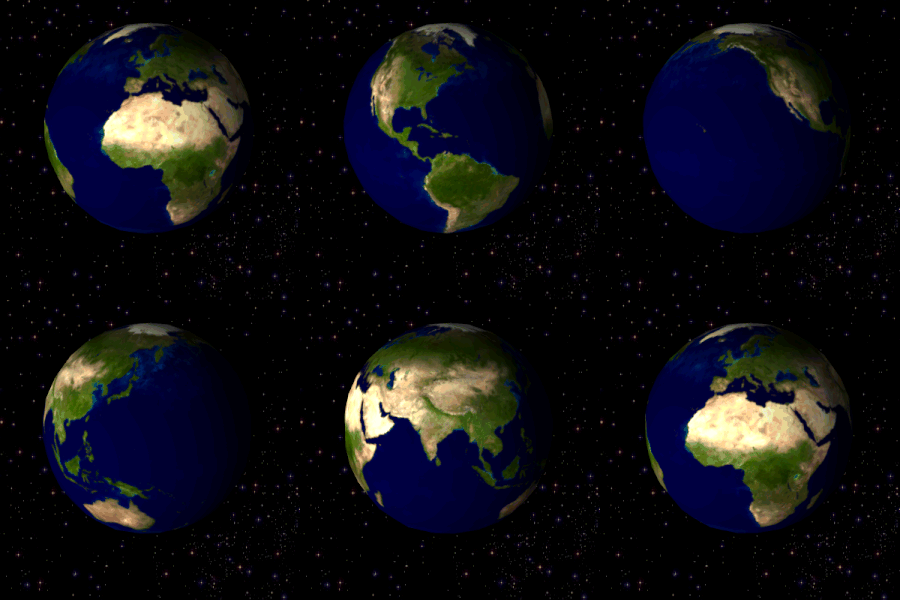
Computer animation encompasses a variety of techniques, the unifying factor being that the animation is created digitally on a computer. This animation takes less time than previous traditional animation.
2D animation
2d animation figures are created and/or edited on the computer using 2D bitmap or created and edited using 2D Vector graphics. This includes automated computerized versions of traditional animation techniques such as of, interpolated morphing onion skinning and interpolated rotoscoping.
2D animation has many applications, including analog cpu animating and flash animating and powerpoint animation. cinemagraphs are still photo's in the form of an animated gif file file of which part is animated.
3D animation
3D animation is digitally modeled and manipulated by an animator. The animator starts by creating an external 3d mesh to manipulate, a mesh is a geometric configuration that gives the visual appearance of form to an 3D object or 3D environment. The mesh may have a lot of vertices which are to geometric points which make up the mesh, it is given an internal digital skeletal structure called an armature that can be used to control the mesh with weights. This process is called rigging and can be programmed with movement with keyframes.
Other techniques can be applied, such as mathematical functions (ex. gravity, particle simulations), simulated fur or hair, effects such as fire and water simulations. These techniques fall under the category of 3D dynamics.
Animation is the rapid display of a sequence of images to create an illusion of movement. The most common method of presenting animation is as a motion picture or video program, although there are other methods. This type of presentation is usually accomplished with a camera and a projevctor or a computer viewing screen which can rapidly cycle through images in a sequence. Animation can be made with either hand rendered art, computer generated imagery, or three-dimensional objects, e.g. puppets or clay figures, or a combination of techniques. The position of each object in any particular image relates to the position of that object in the previous and following images so that the objects each appear to fluidly move independently of one another. The viewing device displays these images in rapid succession, usually 24, 25 or 30 frames per second.
Animation on the T.V. And on the Internet
A simulation of movement created by displaying a series of pictures, or frames. Cartoons on television is one example of animation. Animation on computers is one of the chief ingredients of multimedia presentations. There are many software applications that enable you to create animations that you can display on a computer monitor.
Note the difference between animation and video. Whereas video takes continuous motion and breaks it up into discrete frames, animation starts with independent pictures and puts them together to form the illusion of continuous motion. Flash animation on the internet has been big since 1995 around 2002 this started to get pushed onto television.
My favourite animation on the telly would be Archer. This is because its just funny, not only this but it manages to string a storyline into itself, the lead animater of Archer is Adam Reed
my other faveourite animation is on the internet this would be from david firth, this is called "music mouth" this is about music, as the title would suggest. David firth also does other animations such as salad fingers etc.
Subscribe to:
Posts (Atom)