Thaumartropes run on the basis that our eyes retain the image for 0.004 seconds, so when a peice of paper with a picture on both sides is spun really quickly it creates the effect that both pictures are combined together. such as the classic 'bird in the cage'. seeing in 0.004 second chunks is called "persistance of vision"
Its not that we can only see in 0.004 second chunks its that our mind 'Remembers' the last 0.004 seconds. its too do with our brains taking in these memories. people used too think that it was their eyes that retained that image before going into the brain.
My very own thaumatrope is the second one in, the plantpot and the tree, 'sprouting' out of said plantpot.
Although this principle had been recognized by the Greek mathematician Euclid and later in experiments by Newton, it was not until 1829 that this principle became firmly established by the Belgian Joseph Plateau. Plateau planned it in 1839 and invented it in 1841. Later the same year the Austrian Simon von Stampfer invented the stroboscopic disk, a similar machine. A contemporary edition of Britannica says "The phenakistoscope or magic disc...was originally invented by Dr. Roget, and improved by M. Plateau, at Brussels, and Dr. Faraday.
The phenakistoscope used a spinning disc attached vertically to a handle. Arrayed around the disc's center were a series of drawings showing phases of the animation, and cut through it were a series of equally spaced radial slits. The user would spin the disc and look through the moving slits at the disc's reflection in a mirror. The scanning of the slits across the reflected images kept them from simply blurring together, so that the user would see a rapid succession of images that appeared to be a single moving picture.
A variant of it had two discs, one with slits and one with pictures; this was slightly more unwieldy but needed no mirror. Unlike the zoetrope and its successors, the phenakistoscope could only practically be used by one person at a time. The phenakistoscope was only famous for about two years due to the changing of technology.

The praxinoscope was an animation device, the successor to the zoetrope. It was invented in France in 1877 by Charles-Émile Reynaud. Like the zoetrope, it used a strip of pictures placed around the inner surface of a spinning cylinder. The praxinoscope improved on the zoetrope by replacing its narrow viewing slits with an inner circle of mirrors, placed so that the reflections of the pictures appeared more or less stationary in position as the wheel turned. Someone looking in the mirrors would therefore see a rapid succession of images producing the illusion of motion, with a brighter and less distorted picture than the zoetrope offered.
In 1889 Reynaud developed the Théâtre Optique, an improved version capable of projecting images on a screen from a longer roll of pictures. This allowed him to show hand-drawn animated cartoons to larger audiences, but it was soon eclipsed in popularity by the photographic film projector of the Lumière brothers
Edward Muybridge 9 April 1830 – 8 May 1904) was an English photographer important for his pioneering work in photographic studies of motion and in motion-picture projection. He adopted the name Eadweard Muybridge, believing it to be the original Anglo-Saxon form of his name. He immigrated to the United States as a young man but remained obscure until 1868, when his large photographs of Yosemite Valley, California, made him world famous. Muybridge is known for his pioneering work on anima locomotion in 1877 and 1878, which used multiple cameras to capture motion in stop-action photographs, and his zoopraxiscope, a device for projecting motion pictures that pre-dated the flexible perforated film strip used in cinematography.
In his earlier years in San Francisco, Muybridge had become known for his landscape photography, particularly of the Yosemite Valley. He also photographed the Tlingit people in Alaska, and was commissioned by the United States Army to photograph the Modoc War in 1873. he also found his talent by a bet about horses running!
The Kinetoscope is an early motion picture exhibition device. The Kinetoscope was designed for films to be viewed by one individual at a time through a peephole viewer window at the top of the device. The Kinetoscope was not a movie projector but introduced the basic approach that would become the standard for all cinematic projection before the advent of video, by creating the illusion of movement by conveying a strip of perforated film bearing sequential images over a light source with a high-speed shutter. First described in conceptual terms by U.S. inventor Thomas Edison in 1888, it was largely developed by his employee William Kennedy Laurie Dickson between 1889 and 1892. Dickson and his team at the Edison lab also devised the Kinetograph, an innovative motion picture camera with rapid intermittent, or stop-and-go, film movement, to photograph movies for in-house experiments and, eventually, commercial Kinetoscope presentations.
On April 14, 1894, the first commercial exhibition of motion pictures in history was given in New York City, using ten Kinetoscopes. Instrumental to the birth of American movie culture, the Kinetoscope also had a major impact in Europe; its influence abroad was magnified by Edison's decision not to seek international patents on the device, facilitating numerous imitations of and improvements on the technology. In 1895, Edison introduced the Kinetophone, which joined the Kinetoscope with a cylinder phonograph. Film projection, which Edison initially disdained as financially nonviable, soon superseded the Kinetoscope's individual exhibition model. Many of the projection systems developed by Edison's firm in later years would use the Kinetoscope name.

The Lumière brothers were born in Besançon, France, in 1862 and 1864, and moved to Lyon in 1870, where both attended La Martiniere, the largest technical school in Lyon. Their father, Claude-Antoine Lumière (1840–1911), ran a photographic firm and both brothers worked for him: Louis as a physicist and Auguste as a manager. Louis had made some improvements to the still-photograph process, the most notable being the dry-plate process, which was a major step towards moving images.
It was not until their father retired in 1892 that the brothers began to create moving pictures. They patented a number of significant processes leading up to their film camera, most notably film perforations (originally implemented by Emile Reynaud) as a means of advancing the film through the camera and projector. The cinématographe itself was patented on 13 February 1895 and the first footage ever to be recorded using it was recorded on March 19, 1895. This first film shows workers leaving the Lumière factory.
George Pal (February 1, 1908 – May 2, 1980), born György Pál Marczincsak, was a Hungarian-born American animator and film producer, principally associated with the science fiction genre. He became an American citizen after emigrating from Europe. He was nominated for Academy Awards (in the category Best short subjects, Cartoon) no less than seven consecutive years (1942–1948) and received an honorary award in 1944. This makes him the second most nominated Hungarian exile (together with William S. Darling and Ernest Laszlo) after Miklós Rózsa.

Willis O'Brien March 2, 1886 – November 8, 1962) was an Irish American motion picture special effects and stop-motion animation pioneer, who according to ASIFA-Hollywood "was responsible for some of the best-known images in cinema history," and is best remembered for his work on The Lost World (1925), King Kong (1933) and Mighty Joe Young (1949), for which he won the 1950 Academy Award for Best Visual Effects.
Ray Harryhausen born June 29, 1920 worked with willis o'brien and they used stop animation to make films such as King Kong (1933) and Jason and the Argonauts (1963) these are mostly done using stop motion, e.g. King Kong or the skeletons in Jason and the Argonauts
Jan Svankmajer was born in Prague. An early influence on his later artistic development was a puppet theatre he was given for Christmas as a child. He studied at the College of Applied Arts in Prague and later in the Department of Puppetry at the Prague Academy of Performing Arts. He contributed to Emil Radok's film Doktor Faust in 1958 and then began working for Prague's Semafor Theatre where he founded the Theatre of Masks. He then moved on to the Laterna Magika multimedia theatre, where he renewed his association with Radok. This theatrical experience is reflected in Svankmajer's first film The Last Trick, which was released in 1964. Under the influence of theoretician Vratislav Effenbergr Svankmajer moved from the mannerism of his early work to classic surrealism, first manifested in his film The Garden (1968), and joined the Czechoslovakian Surrealist Group.
He was married to Eva Svankmajerova, an internationally known surrealist painter, ceramicist, and writer until her death in October 2005. Svankmajerova collaborated on several of her husband's movies, including Alice, Faust, and Otesánek. They had two children, Veronika (b. 1963) and Vaclav (b. 1975, an animator).
Svankmajer has gained a reputation over several decades
.jpg)
The Lumieré brothers

Computer animation
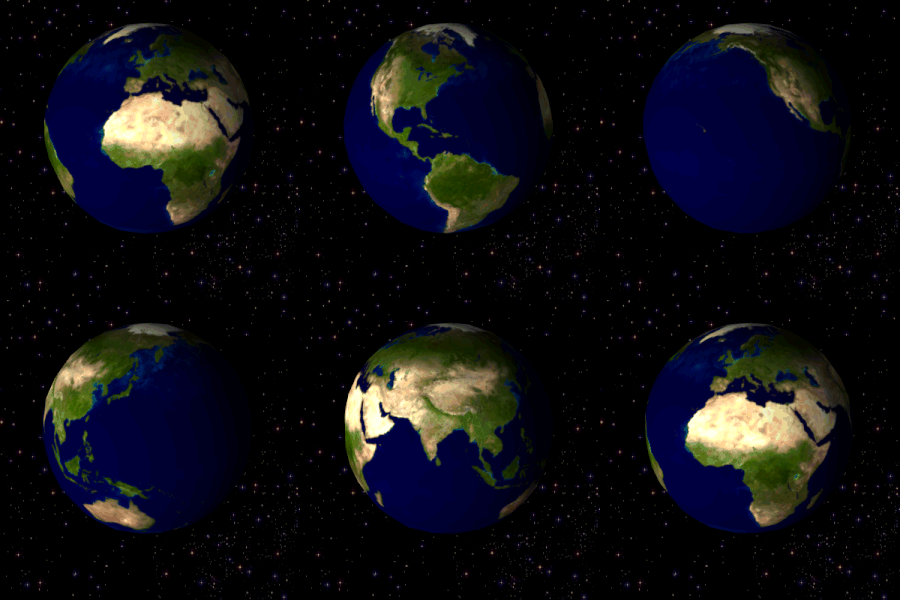
Computer animation encompasses a variety of techniques, the unifying factor being that the animation is created digitally on a computer. This animation takes less time than previous traditional animation.
2D animation
2d animation figures are created and/or edited on the computer using 2D bitmap or created and edited using 2D Vector graphics. This includes automated computerized versions of traditional animation techniques such as of, interpolated morphing onion skinning and interpolated rotoscoping.
2D animation has many applications, including analog cpu animating and flash animating and powerpoint animation. cinemagraphs are still photo's in the form of an animated gif file file of which part is animated.
3D animation
3D animation is digitally modeled and manipulated by an animator. The animator starts by creating an external 3d mesh to manipulate, a mesh is a geometric configuration that gives the visual appearance of form to an 3D object or 3D environment. The mesh may have a lot of vertices which are to geometric points which make up the mesh, it is given an internal digital skeletal structure called an armature that can be used to control the mesh with weights. This process is called rigging and can be programmed with movement with keyframes.
Other techniques can be applied, such as mathematical functions (ex. gravity, particle simulations), simulated fur or hair, effects such as fire and water simulations. These techniques fall under the category of 3D dynamics.
Animation is the rapid display of a sequence of images to create an illusion of movement. The most common method of presenting animation is as a motion picture or video program, although there are other methods. This type of presentation is usually accomplished with a camera and a projevctor or a computer viewing screen which can rapidly cycle through images in a sequence. Animation can be made with either hand rendered art, computer generated imagery, or three-dimensional objects, e.g. puppets or clay figures, or a combination of techniques. The position of each object in any particular image relates to the position of that object in the previous and following images so that the objects each appear to fluidly move independently of one another. The viewing device displays these images in rapid succession, usually 24, 25 or 30 frames per second.
Animation on the T.V. And on the Internet
A simulation of movement created by displaying a series of pictures, or frames. Cartoons on television is one example of animation. Animation on computers is one of the chief ingredients of multimedia presentations. There are many software applications that enable you to create animations that you can display on a computer monitor.
Note the difference between animation and video. Whereas video takes continuous motion and breaks it up into discrete frames, animation starts with independent pictures and puts them together to form the illusion of continuous motion. Flash animation on the internet has been big since 1995 around 2002 this started to get pushed onto television.
My favourite animation on the telly would be Archer. This is because its just funny, not only this but it manages to string a storyline into itself, the lead animater of Archer is Adam Reed

my other faveourite animation is on the internet this would be from david firth, this is called "music mouth" this is about music, as the title would suggest. David firth also does other animations such as salad fingers etc.


Sam,
ReplyDeleteWell done for getting the work completed and ON TIME! Please do just go back and ensure all text is white as the black writing is not visible with your current background. You must also go through the post and capitalise all names, programmes and films and italicise media texts too.
At the moment you have achieved P1.
In order to aim for M1 and D1 you must add lots more detail and also images/examples. I would like to see fra more of your own words in this post too as at the moment it reads more like a Wikipedia entry rather than a student's Blog. Take only the RELEVANT information and use it to demonatrate how it has helped you understand where animation began and how it has evolved.
See me if you would like any more help or guidance.
EllieB
IMPORTANT - PLEASE DO NOT DELETE COMMENTS - EVEN WHEN CHANGES HAVE BEEN MADE!
ReplyDelete